
Meet the Second Health Founders Estonia Cohort
From antiviral therapies and monoclonal antibodies to AI-powered imaging and hospital triage, 39 teams are selected to the second Health Founders Estonia (HFE) accelerator cohort. Spread across our three programs (DEFINE, DEVELOP, and GROW), they represent the next wave of Estonian digital health and life sciences. Seven of them are continuing on from our first batch into the next stage of the program, which means this is the first cohort we have opened that did not start from zero.
What Two Cohorts Tell Us
Last year we wrote that Estonia was positioned to become more than a testing ground for health technology. A year on, we have a second cohort to compare against the first, and some patterns are becoming clear enough to be worth sharing.
Applications grew. 59 companies applied this year, compared with 47 for Batch #1. That is a 26% increase in a single year, from a country of 1.3 million people. For anyone assessing whether Estonia has enough health tech deal flow to build on, the direction matters more than the absolute number.
The digital and life sciences balance is holding. Across both batches we now have 64 companies, split 58% digital health and 42% life sciences. Last year the mix was close to even in DEFINE, digital-led in DEVELOP, and digital-only in GROW. This year the same broad balance repeats at nearly twice the sample size and with a different applicant pool behind it. One cohort could have been a quirk of a single selection round. Two is a pattern worth paying attention to.
Two clocks are running inside that portfolio, and it shapes how we run the program. Digital teams can put something in front of users within months and find out quickly whether anyone wants it. Life sciences companies work to timelines measured in years, where the meaningful milestone is a study result or a regulatory pathway rather than a customer signature. They also build value that is much harder to copy. A program designed only around the faster teams would quietly disadvantage nearly half the portfolio, so our workshops, mentoring and roadmapping have to hold both.
The network is compounding. HFE now connects 300+ mentors, 150+ partners and 100+ investors. That is the part of an accelerator that cannot be built in year one, and it is what the second cohort inherits: a bigger pool of lead mentors to match against, more partners with a reason to take a meeting, and alumni who have already been through the same first six months.
Why This Matters
The market these teams are entering has shifted since our first cohort started. Frontier AI is roughly 88% cheaper than it was in March 2023, which means the technology itself is rarely the differentiator any longer. Funding has recovered, with $7.4B into digital health in the first half of 2026, but nearly half of that landed in 20 mega-rounds representing just 8% of all deals. Capital is concentrating around companies that can show evidence rather than promise.
Meanwhile demand is rising. 29% of Europeans will be over 65 by 2050, up from 21% today. Europe faces a shortfall of 11 million health workers by 2030, and four in ten doctors report burnout with paperwork rather than patients as the leading cause. Health systems know they cannot solve this from the inside.
What is scarce, then, is proof that something works for a patient and for a system. Estonia is unusually well placed to produce it: first in the Bertelsmann Digital Health Index, 99% of health data digital, 20 years of national e-health, and 1.3 million people accustomed to using digital services. The Ministry of Social Affairs innovation roadmap for 2025 to 2030 commits to a health AI roadmap and regulatory sandboxes by 2027 and names Health Founders Estonia as a delivery partner.
From Applications to Acceptance
Teams were selected through a multi-step process including Dealum submissions, CIMIT self-assessments, video pitches and interviews, with final decisions made by an Assessment Committee of HFE consortium partners and ecosystem experts.
Spotlight on the Cohort
25 teams are joining DEFINE, 10 are in DEVELOP, and 4 are in GROW. Seven teams marked below are continuing on from Batch #1. The work ranges from triage, diagnostics and clinical decision support for overstretched clinicians, to women’s health, ageing at home, chronic disease adherence and mental wellbeing for patients between appointments, to antiviral therapies, monoclonal antibodies, 3D-printed dosage forms, bioassay platforms and wound care on the life sciences side. AI runs through roughly a quarter of the cohort, appearing in imaging analysis, diagnostics and clinical reasoning rather than in conversational tools.
The DEFINE program:
- Antimicrobial surface coatings: developing coating methods to tackle surface-transmitted microbial infections.
- Aptomix: next-generation bioassay technology for drug discovery and medical diagnostics.
- ARAM: precision actuator and AR-based control systems for prosthetics and robotic applications.
- Avirogen: antiviral therapies to help patients treat cancers driven by oncogenic viruses.
- Bluehills: an intelligent tool addressing a critical challenge faced by doctors and healthcare professionals.
- BuddyDouble: a social productivity platform helping people with ADHD overcome task paralysis.
- Causalis: a digital health tool helping adults make lifestyle changes stick, using behavioural diagnostics.
- Enerium Health: an all-in-one fitness and healthy lifestyle app with AI support.
- EPSKE: a biopsychosocial prevention service supporting employee health through early, coordinated interventions.
- Farma 3D Tartu: personalised dosage forms produced using 3D printing.
- Honest Nektar: innovative bee products for Estonia and export markets, combining tradition and science.
- IAMOS Health: an MDR Class I search engine letting clinicians query HIS and X-Road data in natural language.
- InnerLoop AI: a Human State Modelling Engine helping coaches interpret athlete condition with neuro-symbolic AI.
- Intellektist: a personalised health analytics platform built on genetic and biological data.
- MaternaFlow: a co-pilot connecting self-reported vitals to the care team so midwives spot risks before they escalate.
- Mz Medical: a digital platform for midlife women, integrating data and coordinating fragmented care.
- NeuroTech AI: an AI-powered diagnostic and therapy platform for people with neurocognitive disorders.
- OnkoGlove: PCM cooling gloves helping chemotherapy patients reduce neuropathy risk.
- Scad: a digital pre-triage system helping hospitals reduce non-urgent cases.
- Servarray: a smart hospital queue and registration platform automating the path from front door to doctor.
- SmartFlutter: home rehabilitation for COPD patients, made more efficient and more engaging.
- TERA: a mobile app helping people recover from elbow pain through evidence-based rehabilitation exercises.
- TriageEST: a real-time patient triage system improving situational awareness in mass casualty situations.
- Vitra: a science-backed health app helping women build a healthy lifestyle through research-based monthly challenges.
- VIVIA: a virtual companion paired with a family platform to coordinate and prioritise older adults’ wellbeing.
The DEVELOP program:
- AgentX: a multi-agent platform helping clinics carry patient cases from triage to treatment.
- AURAGUARD (continuing from Batch #1): an AI-based home monitoring and communication device for elderly or chronically ill people.
- CareHand (continuing from Batch #1): a smart patient slider enabling safe, effortless transfers while reducing physical strain on caregivers.
- Glurry (continuing from Batch #1): a behaviour-change app helping diabetes patients improve adherence through AI-driven insights and goals.
- Lävi Clinical: an AI-powered longitudinal MRI analysis platform helping clinicians detect and quantify disease progression.
- Milo (continuing from Batch #1): an AI-powered speech therapy app helping children aged 3 to 10 improve their speech.
- Padakonn Pharma (continuing from Batch #1): monoclonal antibodies targeting vasoconstriction, fibrosis and impaired microcirculation.
- PropsAid (continuing from Batch #1): ultra-realistic wound training aids for medical and military simulation, to buy or rent.
- Slycora: a planning app that works out what to do next, adapts when life changes, and turns overwhelm into clear steps.
- Supercharger Labs (continuing from Batch #1): functional ingredients for sunscreen and moisturiser producers.
The GROW program:
- Dermtest: a software platform enabling any medical professional to treat specialist conditions.
- Nanordica Medical: first-in-class wound care products for fast healing of chronic wounds.
- Salu: a licensed healthcare provider offering online and in-person care through a subscription model.
- Siffi: one-click access to workplace mental wellbeing, with self-profiling and counselling sessions.
The Opening Event
On 23 August we opened the cohort at Õpiku maja in Tallinn, with almost 70 founders in the room. Louis Zezeran moderated the day and ran an afternoon workshop on leadership principles drawn from military service and from comedy. Thank you to Susie-Ann Palmre for leading the movement breaks between the pitch rounds, which kept the room going through a long morning of introductions.
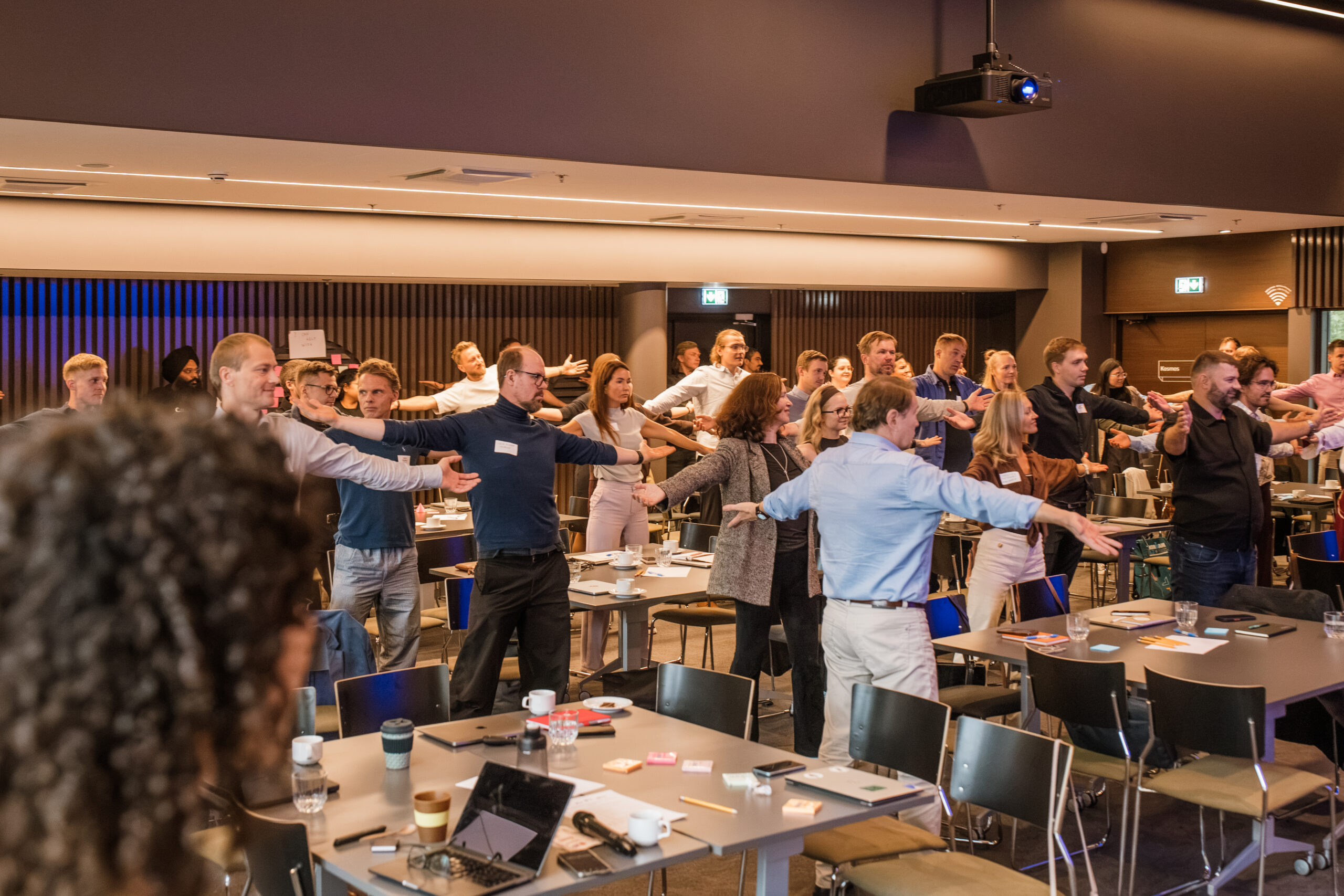
Each team had one minute on stage to introduce who they are, what they are building, and what they need from the room. Networking breaks were structured so founders could find the people they had just heard from, and the day closed with dinner at Mona.
The format was a deliberate change from last year, when the emphasis was on the program and its mentors. This year we put founders at the centre and gave them reasons to talk to each other.
The most valuable part of the day happened between the sessions. Founders who had never met each other in the morning were arranging follow-up conversations by dinner. Several asked whether they could drop into our office to keep talking, and the first company was working from there the following morning. These are the people who will recommend the same regulatory consultant, warn each other off a supplier that wasted three months, and turn someone else’s hard-won lesson into a twenty-minute conversation. For an early-stage health company, that is time and money that never appears on an invoice.
What’s Next
Mentor matching is our immediate next step. Every company is assigned a dedicated lead mentor with domain-specific mentors engaged as needed matching is based on actual need rather than sector labels.
From there the program runs at two workshops a month plus bi-weekly roadmapping sessions DEFINE teams. DEVELOP and GROW teams work to tailored roadmaps with a budget for product and business development services.
Every company is also given a flex desk at the Health Founders office in Tallinn or at Tartu Science Park, and DEVELOP and GROW teams receive a budget for product and business development services drawn against their agreed roadmap.
The HFE program is delivered by a consortium of the Estonian Health Economy Association, the University of Tartu, Sparkup Tartu Science Park and Civitta, and is funded by the EU through Enterprise Estonia in collaboration with Startup Estonia.