
Five technologies, 24 students, five recommendations: Science-based Entrepreneurship 2026 at the University of Tartu
In September we invited Master’s and doctoral students to spend six weeks testing whether University of Tartu research results have a market. The Science-based Entrepreneurship course ended on 26 October. 24 students worked in five teams, and each team closed with a recommendation on how its technology could reach the market.
Each team took one real research result from the commercialisation portfolio of the University’s Centre for Entrepreneurship and Innovation. They mapped the possible applications, tested their assumptions in interviews with experts and prospective users, and closed with a route to market: licence, spin-off, industry partnership, or a deliberate decision not to proceed.
Here is where they landed.
OPTOMICS explores optoacoustic imaging of small blood vessels under the skin for type 2 diabetes risk assessment. Nine interviews with GPs, endocrinologists, nurses, a paramedic and people living with diabetes pointed in one direction. A tool like this would complement blood tests, not replace them. The next step is validation against HbA1c, fasting glucose and OGTT.
HUMB is the University’s Human Microbiota Biobank, with over 20,000 bacterial strains. Both probiotics R&D teams and academic labs said they need human isolates, and they value source and resistance data most. The team recommends selling strains non-exclusively first, then licensing a strain that works for exclusive commercial use, with paid data services on top.
RoboBioChemist moves droplets electronically on a chip to automate biochemical experiments. Labs said they did not mainly want to save time on pipetting. They wanted to run more experiments. The team recommends proving one screening workflow with one partner lab before scaling, with revenue from software, protocols and service rather than the chip itself.
IHIS is an optic that lets depth be chosen after an image is taken. The team sent 121 emails to 101 organisations in 23 countries and came out with a software-first plan, starting with quality control in 3D printing. It recommends partnering with an established hardware company for manufacturing and distribution, while keeping the software and analysis in-house on a subscription model.
The bio-based coatings team held six interviews with Tartu food businesses, which showed that most packaging uses fall short for now. The team recommends validating the material for indoor eco-paints before a pilot.
Two teams also set a stop rule: the result that would tell the researchers to drop the idea. That is a useful habit for any lab.
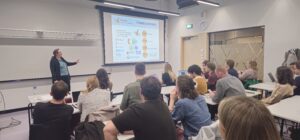
Guest lecturer Amy Weatherup. Photo Kaisa Põhako-Palu.
In the final session, the teams presented their work and received feedback from the Innovation Scouts of the University of Tartu Centre for Entrepreneurship and Innovation, lecturer Liis Narusk, and guest lecturer Amy Weatherup, Director of i-Teams at the University of Cambridge.
Thank you to lecturers Tõnu Esko, Kadri Sundja, Liis Narusk and Samela Kivilo, and three entrepreneurship agents Elina Aleksejeva-Zagura, Siimeon Elias Pilli and Aleksander Tõnnisson from the Centre of Entrepreneurship and Innovation, who served as mentors to the teams during the course. Thank you to the researchers who opened up their work to the students. The course is run by the University of Tartu as part of Health Founders Estonia.
HFE is Funded by the European Union through EIS | Enterprise Estonia in cooperation with Startup Estonia, to develop a strong and globally competitive healthtech ecosystem in Estonia.