
Event Recap: HFE Regulatory Session III on AI in MedTech
Matthew DiFranco’s three-part keynote and a panel with Siim Nahkur, Toomas Seppel and Hille Hinsberg looked at what it takes to build, regulate and scale AI in healthcare.
On 19 March, the third edition of the Health Founders Estonia Regulatory Sessions took place at Mektory in Tallinn and online. The topic was artificial intelligence in MedTech: where AI-based products sit in the regulatory landscape, what happens when they meet clinical practice, and which risks regulators and clinicians watch most closely.
The session was aimed at MedTech start-ups and scale-ups developing AI-powered products or using AI in their quality and compliance work, and at public sector representatives, researchers and others involved in healthcare regulation and AI governance.
From clinical evaluation to AI
The Regulatory Sessions are our recurring format for founders working towards MDR and IVDR compliance, and for the public sector and ecosystem partners who support them. Each edition combines an expert keynote with practical discussion, so that participants can take the lessons straight into their own regulatory work.
The first session, in June 2025, covered clinical evaluation under MDR and FDA. The second, in October 2025, focused on quality management systems under MDR/IVDR, risk management and audit readiness.
The third edition moved to AI. For companies building with it, the regulatory questions now reach across software, data and clinical workflow at the same time. Matthew DiFranco, who also led the two previous sessions, returned as keynote speaker.
One keynote in three parts
Matthew delivered his keynote as a single talk in three parts, each followed by questions from the audience.
Opportunities. The first part ran from wellness apps and SaMD to lifecycle automation and LLM-powered compliance. The line between a wellness app and SaMD matters in practice: under MDR, the intended purpose of a piece of software determines whether it is regulated as a medical device at all.
Challenges. The second part looked at performance, integration into clinical workflows and user needs. In other words, what happens when an AI tool leaves the development environment and meets real clinical settings.
Risks. The third part covered cybersecurity, bias, overreliance and performance drift, the risks that concern regulators and clinicians most.
Four points that stayed with us
Average performance can hide poor outcomes. An AI model with strong average results can still perform poorly for vulnerable patient groups. Matthew framed this as a regulatory and ethical problem as well as a technical one. For founders, it means looking beyond headline accuracy figures when validating a product.
LLMs cut both ways in regulatory work. Large language models can help draft a clinical evaluation report. They can also hallucinate regulatory claims and carry them straight into a technical file. For teams using these tools, anything AI-drafted still needs expert review before it becomes part of the documentation.
Automation bias is a design question. Clinicians working under time pressure may accept AI recommendations without questioning them. That makes human-centred interface design and clear lines of accountability essential parts of the product, not later additions.
Risk management is what makes adoption possible. Perhaps the most important framing of the day was that risk management does not slow innovation down. It is the precondition for clinical AI to be adopted in the first place. Trust in AI is fragile, and a single incident can set back confidence across an entire region.
Three perspectives on the panel
The keynote was followed by a panel discussion, “AI in MedTech: Real-World Perspectives from Entrepreneurs, Consultants and Governance Experts”. It brought the entrepreneur, legal and governance views into one conversation about what it takes to build, regulate and scale AI in healthcare. Hille Hinsberg, product manager at Proud Engineers, spoke on governance and implementation. Siim Nahkur, founder and CEO of Synbase, spoke from the perspective of a company building the technology and Toomas Seppel, partner and attorney-at-law at Hedman Partners & Co Law Office, brought the legal view.
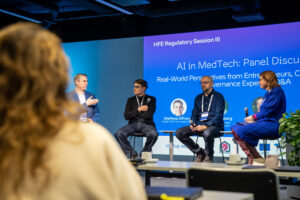
Photo: Carolina Linnamägi
Watch the recording
The full livestream recording is available here.
Thank you to Matthew for a dense and practical keynote, to Siim, Toomas and Hille for a discussion that gave participants plenty to take back to their own work, and to the Startup Garage student organisation for helping the event run smoothly.
Regulatory readiness in the HFE programmes
Regulatory readiness is a core focus of DEVELOP, one of HFE’s three accelerator programmes, which concentrates on product development, clinical validation and regulatory readiness. DEFINE supports early-stage teams moving from an idea to a validated business model, and GROW supports companies ready for international growth and export. The next Regulatory Session will be held in autumn 2026.
HFE is Funded by the European Union through EIS | Enterprise Estonia in cooperation with Startup Estonia, to develop a strong and globally competitive healthtech ecosystem in Estonia.