
Estonian HealthTech Week 2026 in Tartu: personalised medicine, hospital innovation and what it takes to fund a health breakthrough
During Estonian HealthTech Week 2026, the Health Founders Estonia team spent a full day in Tartu. The afternoon took us to Tartu University Hospital, where clinicians, researchers and innovators looked at how data is changing the way disease is understood, prevented and treated. In the evening, founders, investors and funders continued the conversation at DeepTech Pub: Health Edition. This time the topic was funding.
Innovation Seminar at Tartu University Hospital
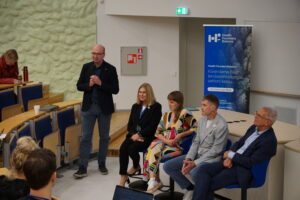
The seminar was organised by Tartu University Hospital together with the University of Tartu, the TeamPerMed Centre for Data-Enriched Personalised Medicine, Tartu Biotechnology Park and Health Founders Estonia. Dr Katrin Kaarna gave the opening remarks and an overview of the hospital’s research and development work.
What we heard:
- Data Circle: Alar Irs gave a keynote on Data Circle, an Eesti.ai initiative. National identifiers and largely digital records make population-scale work possible in Estonia, and his work on a cardiovascular care data pathway is one of the pilots. He argued that the secondary use of health data depends on public trust. That trust is not a given: it is earned when results flow back into care and improve data quality where the data is first recorded.
- Health Founders Estonia success so far: During her presentation, Katrina Laks set out why Estonia is a good place to build health technologies. Estonia as a country has more than two decades of national electronic health records, a biobank whose genetic data can be linked with those records, and an ecosystem to support health technologies to move faster. She described the hospital’s role in our programmes, from identifying unmet clinical needs to introducing early-stage companies access to clinicians and patients when they need the first feedback to their product. Most problems in healthcare are still unsolved, and technology is one tool for solving them. For companies, the harder part comes once the product exists: building evidence and getting the solution adopted. Tartu University Hospital is one of the institutions that understands the need of taking new solutions into use.
- Polygenic risk in primary care: In a video presentation, Ave Voit from the Institute of Family Medicine and Public Health at the University of Tartu presented a pragmatic randomised controlled trial. It is testing statin therapy guided by polygenic risk for cardiovascular disease prevention. Participants are Estonian Biobank members in the top 20% of genetic risk for coronary artery disease. The intervention combines risk counselling with preventive treatment delivered by family physicians, while the control group continues standard care. The hospital’s Clinical Research Centre supports the trial with GCP training, study nurses and central monitoring. Her main point: a real-world trial cannot copy classical trial rules one to one. They have to be adapted.
- CAR-T cell therapy: Ain Kaare explained the plan to manufacture CAR-T cells at Tartu University Hospital under the hospital exemption, in cooperation with Icosagen and North Estonia Medical Centre. CAR-T cells are genetically modified immune cells designed to recognise and attack cancer cells. Patients in Estonia who need the therapy currently have to travel abroad, and commercial CAR-T products cost around half a million euros per patient. Producing the cells at the hospital is meant to lower the cost and shorten the process. The protocol, more than 2,000 pages long, is ready, and in September the hospital opened a cleanroom complex where the cells can be produced.
- Clinical validation model and dynamic informed consent: Kaisa Põhako-Palu presented two tools the hospital is preparing. Dynamic informed consent is designed to explain to patients which of their health data is needed, why, and how it is shared with researchers, with explanations available at the time the data is used. And the clinical validation roadmap, developed under Health Founders Estonia project,sets out a step-by-step route for companies that want to test their solutions at the hospital.
Panel: Personal Medicine 2.0
The seminar closed with a panel titled “Personal Medicine 2.0: let’s look further than genes and health data”. Dr Sander Pajusalu moderated the discussion between Dr Katrin Kaarna, Ain Kaare, Jaanus Pikani and Katrina Laks.
Key takeaways:
- Personalisation is a process, not a new idea: Doctors have always tailored treatment to the patient. What changes is the quality of the data and the tools. Treatment is more personalised than it used to be, and it will keep moving in that direction.
- From paper diaries to dashboards: Katrina Laks used the migraine management pathway as an example. A neurologist once worked from a patient’s paper headache diary. Now patient-reported data can reach the clinician on a digital dashboard in real time and be followed retrospectively if needed. From the clinical side, the panel added that patients value being followed in between visits, and the same applies to remote support after a heart attack, stroke etc.
- The evidence question: Ain Kaare noted that haematological cancers are rare and split into many subtypes, sometimes with a single patient per subtype in Estonia. Dr Katrin Kaarna said randomised double-blind trials remain the standard, but personalised medicine needs different trial designs and a change in mindset. She added that deep personalisation also has a cost ceiling.
- Expectations versus reality: Jaanus Pikani, who helped found the Estonian Biobank more than 25 years ago, recalled early expectations that personalised medicine would arrive within five years. Useful applications take far longer to adopt. The polygenic risk pilots alone took about a decade.
- AI, carefully: Panellists want AI that explains the biology behind its output rather than acting as a black box. They see its first practical use in structuring the large share of clinical data that is currently unusable. Katrina Laks added that large language models are only as smart as the people using them.
- The real test is adoption: Asked about the wider challenge for society, panellists raised two concerns. The first is whether future clinicians will be able to judge the accuracy of AI-supported decisions. The second is whether doctors, nurses and patients will adopt what is being built.
DeepTech Pub: Health Edition
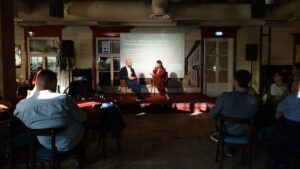
In the evening, the conversation moved to Vilde & Vine for DeepTech Pub: Health Edition, co-hosted with EIS | Enterprise Estonia and Startup Estonia. The fireside chat asked what it takes to fund a health breakthrough. Alexandra Balkova, Accelerator Programmes and Investor Relations Lead at Health Founders Estonia, brought 11 years of experience as a generalist venture investor. Indrek Heinla, Health Tech Focus Area Lead at EIS, brought the public funding perspective. Both asked the room to interrupt them, and it did. They also asked the audience whether Estonia’s first health tech unicorn has already been founded. Nobody thought so, but several expect it is still to come.
Highlights from the discussion:
- What holds companies back: Voices from the floor named regulation, reimbursement models that are not agile enough, business models that give adoption no driver, and too little collaboration between hospitals. One comparison stayed with the room. Germany has around 1,600 hospitals that struggle to share data with each other, while Estonia has two main hospitals working on it. A solution that works here could then scale there.
- Small can be fast: Indrek Heinla said Estonia’s size limits scaling but helps elsewhere. In a small, low-corruption system, a problem spotted by a regulator can lead to a change in the law. His example was the hospital exemption, which has opened a route to treatments that were previously unavailable in Estonia. Estonia’s reputation as a sandbox is still partly a buzzword, he said, but the capability is there.
- A mismatch in timelines: Alexandra Balkova explained that traction in a single clinic or market is rarely enough for a venture investor. Investors look for proof that the problem exists in several markets. In health tech that takes seven to ten years, longer than most private capital expects.
- Public funding, private match: Indrek Heinla said funding is available and it is a good time to build a health tech company in Estonia. The difficulty is a chicken-and-egg problem: public funders want private co-investment to reduce risk, while private investors hesitate at the early stage. Public funding rules must apply equally to everyone, which is part of what keeps the system clean. EIS is open to ideas for better rules. One idea is to direct public support to projects with clear societal impact that private capital will not fund.
- Where change starts: Alexandra Balkova closed on a point about community. In a small country, each person in a clinic or an agency can own the change they are able to make. That could let Estonia become a validation playground for adoption.

Across both events, the same words kept coming back: clinical adoption. Much of the surrounding infrastructure is already in place. What moves Estonian health tech forward is getting solutions tested, trusted and used – fast.
Thank you to Tartu University Hospital, the University of Tartu, TeamPerMed, Tartu Biotechnology Park, Enterprise Estonia, Startup Estonia, and every speaker and participant who joined us in Tartu.
HFE is Funded by the European Union through Enterprise Estonia in cooperation with Startup Estonia, to develop a strong and globally competitive healthtech ecosystem in Estonia.